
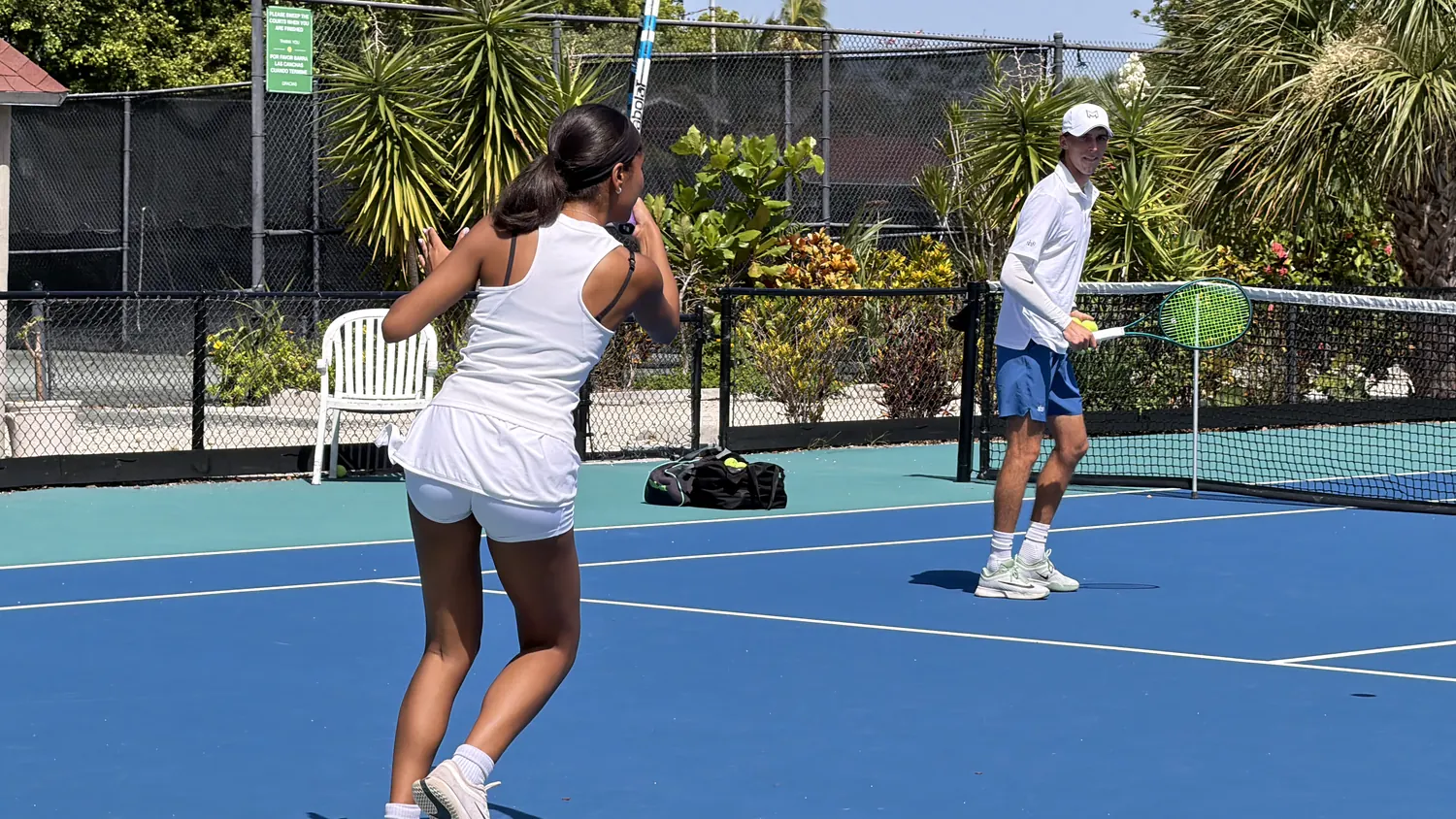
Most people book their first cardio tennis session with the same quiet worry: that it will either be a fitness class that happens to be held on a tennis court, or a drill session so serious that nobody smiles. It is neither. Here is exactly what the hour looks like, from the first ball to the last point.
The first twenty minutes: drilling with a purpose
Every session opens with fifteen to twenty minutes of drilling. The obvious job of this block is to warm you up, and it does that — you will be moving and breathing hard within about four minutes. But the real job is technical.
Each session has a theme, and the drilling goes after one specific part of the game. One night it is transitions and volleys: getting forward off a short ball, splitting, and finishing at the net instead of drifting into no man’s land. Another night it is serve and return, or defending wide and recovering, or the crosscourt rally patterns that decide most club points before anyone gets near the net.
That theme is the reason this block is not just cardio. You are fed a lot of balls in a short window, with a coach watching and correcting, on one clearly defined thing. Twenty minutes of that, once a week, adds up faster than most people expect — and because it is the same thing repeated with feedback, it actually sticks.
Why themes matter: if you come to four sessions in a month, you will have done concentrated work on four different parts of your game — rather than four slightly different versions of the same rally.
Then the drilling stops and the games start
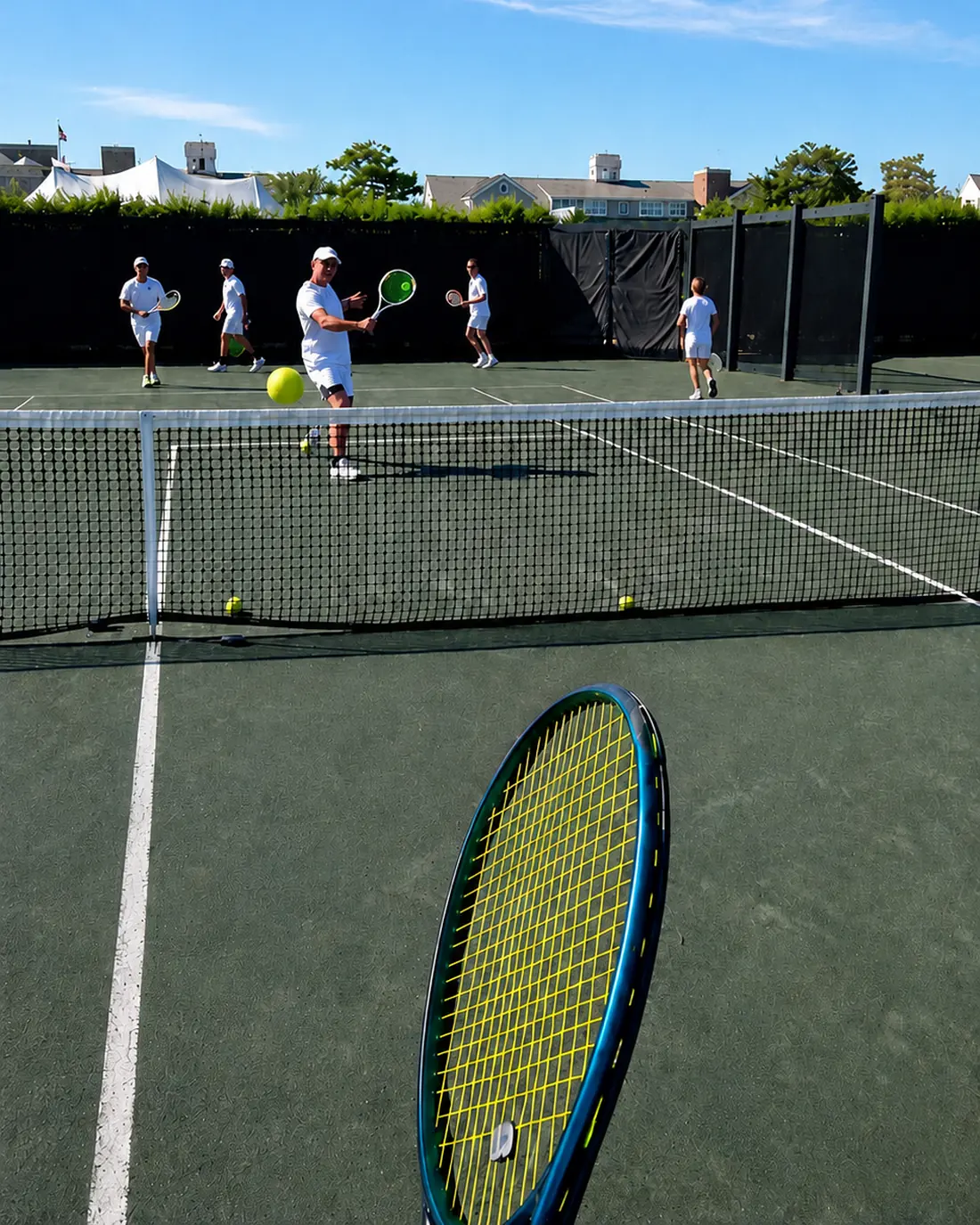
This is the part people come back for. Once the technical block is done the session shifts into competitive doubles games, and the energy changes completely. Nobody is thinking about their heart rate any more, because they are too busy trying to win the point.
Everything is played in a doubles format — two players a side — and we rotate through a set of games, so no two sessions feel the same.
King of the Court
Two players hold the king side. Everyone else waits on the challenging side, usually as two pairs. The coach feeds the first ball to the challengers at the baseline, and if they win that point they move in and get a second feed at the net. Win that one and they get an overhead. Take all three in a row and they sprint for the king side — you get a three-second countdown to make it across.
There is one shortcut. Hit a clean winner, one the kings never touch, and you go straight over and bump them — no three-point sequence needed. It rewards exactly what decides real doubles points: taking the ball early and finishing it.
105 Doubles
A team race to 105 points, and the scoring is what makes it. An ordinary point is worth one. A groundstroke winner off either wing is worth ten. A volley winner is fifteen. An overhead winner is twenty.
You can grind out ordinary points all night and barely move the score; two overheads and you have jumped twenty. So the game quietly teaches the thing most club players avoid — get to the net and finish. It works well with six players, and it is a team game, so your partner’s winners are your winners too.
Offense–Defense
Four players, everyone starting on the baseline. Win the point and your team charges the net and plays the next one from there. Lose it from the net and you sprint back to the baseline while the other team takes your place up front.
So both teams are permanently going up and coming back, and you spend the whole game either attacking or defending with nothing in between. It is the most honest cardio in the session, and the fastest way to learn what a defensive ball is actually for.
Bump
Two courts, eight players, four sides ranked one to four — court one is the top, court four the bottom. You play in pairs, first to two points in a best of three. Win it and your pair bumps up a side: win on three and you move to two, win on two and you move to one.
The aim is to reach court one and stay there, because that is where the points count. It keeps you playing against people at roughly your level all session, and defending the top court turns out to feel very different from chasing it.
Charge
Built entirely around getting forward. The feed forces somebody to come in, so the point plays out with one team attacking off an approach and the other defending or trying to pass.
It is the live version of whatever you drilled twenty minutes earlier — this time against someone actively trying to make you look silly.
Redline
The pure cardio one. Same king-and-challenger structure as King of the Court, but the coach feeds continuously and there is no serving at all, so the next point starts before you have caught your breath. Miss one, and the next ball is already in the air.
Because every point begins from a feed rather than a serve, nobody stands around waiting and nobody’s hour is ruined by their ball toss. This is the game that makes people check their watch and find twenty minutes have gone.
Clockwork
Two teams of three, but only four players on court at a time — two a side, with one player from each team waiting on the sideline. Here is the twist: only winners score. An unreturnable ball is a point. Everything else — errors, ordinary rallies, points won because someone missed — is worth nothing at all.
Lose a point and your team rotates clockwise immediately, with the player who was waiting sprinting on to fill the gap. The coach feeds the next ball to the winning side straight away and does not wait for you, so a slow rotation means playing two-against-one until you sort yourselves out. It is chaotic in the best way, and it is the game that most reliably turns a polite group into a loud one.
Challenger
Two teams going head to head, usually six a side. Each team sends a pair over to the challenging side of the other team’s court, and that pair defends ten lives. Every point they lose costs one; when all ten are gone, the next pair from their team comes on.
It is the most social game we run, because you spend half of it on the sideline willing your own pair on, and the other half out there with your team doing the same for you.
And there are more — the list keeps growing, mostly because players keep asking for the game they liked last week.
The music is not a gimmick
There is music running through the whole hour, and it changes how the session feels more than you would expect. It fills the gaps, it keeps the tempo up between points, and — the honest reason it works — it makes people less self-conscious. A group of six strangers is a lot easier to relax into when there is something in the air besides the sound of your own footwork.
Six players, and why that number matters
Sessions cap at six. That is not a marketing number, it is the point at which everyone still gets real repetitions and the coach can still see what your forehand is doing. At eight or ten, cardio tennis quietly becomes a queue.
Six also means the social side works. You learn names, you end up on the same team as someone twice in a night, and after a few weeks you are playing with people rather than near them. The business is called Cardio Social for a reason.
What you actually need to bring
A racquet, court shoes, and water. That is it. Balls are provided, the coach runs everything, and there is nothing to prepare beforehand. If you are between racquets or borrowing one, say so when you book and we will sort you out.
“Am I fit enough?” and “Am I good enough?”
These are the two questions that come up most, and the answer to both is that the session scales to you. The drills adjust, the games are chosen for the group in front of us, and there is no version of this where you are the person holding everyone up.
What matters more is playing with people around your level, which is why sessions are split into two tracks — beginner/intermediate at NTRP 1.5 to 3.0, and intermediate/advanced at 3.0 to 4.5. If you are not sure where you sit, that is a completely normal thing not to know, and the fastest way to find out is to come to one and let us tell you.
Come and try it.
Groups cap at six players, so everyone gets real reps. Pick a session that suits your week and come and play.
See the schedule
Comments
Got a question about this, or something to add? Leave it below — comments are read and published by hand, so give it a day or so to appear.