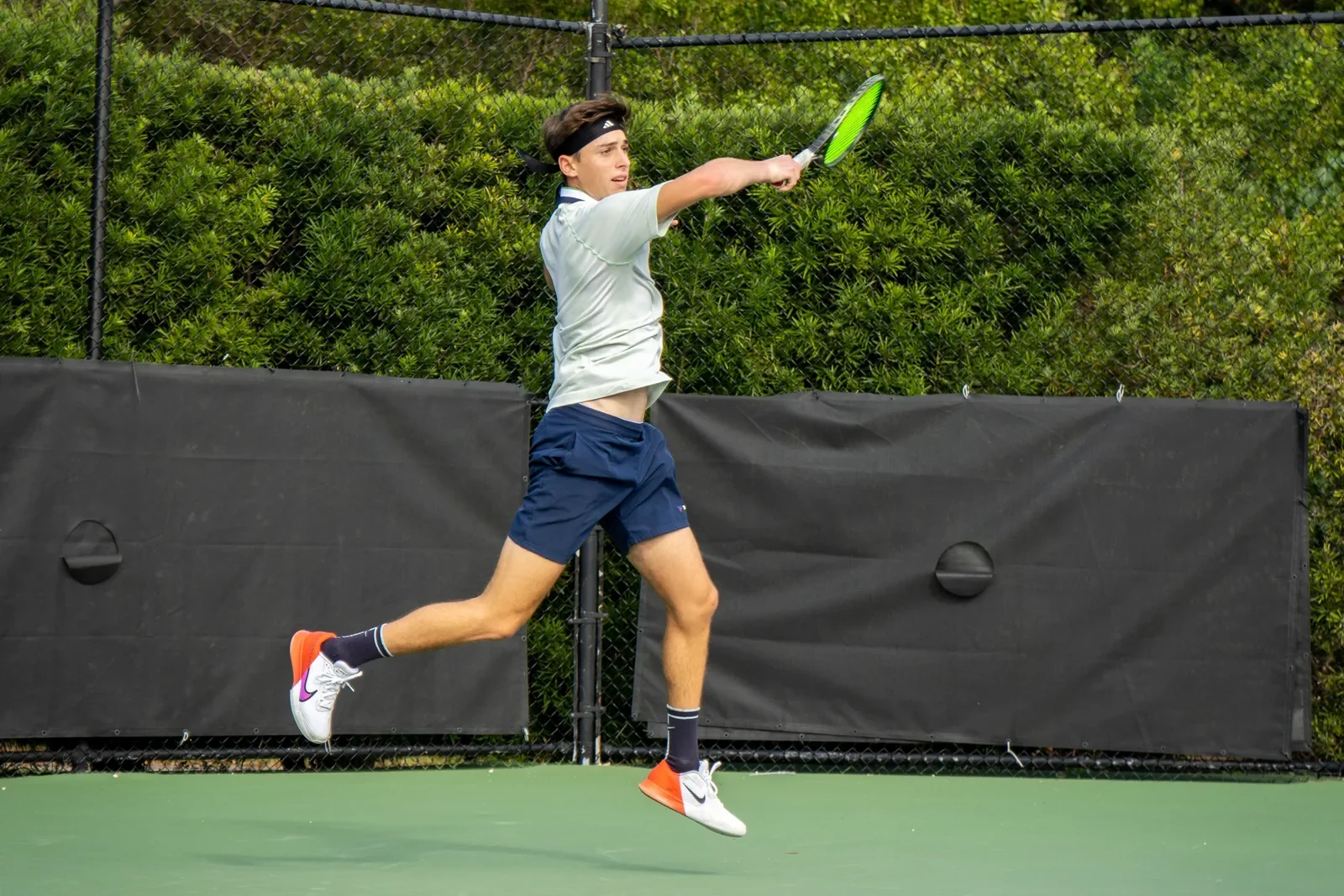
Cardio tennis
The flagship hour. Twenty minutes of themed drilling, then competitive doubles games — King of the Court, 105s, Bump, Clockwork — with music on and the score kept. Six players max, and you're moving the whole time.
Turn up on your own, leave with a group. Small sessions, real coaching, and a court full of people who play at roughly your level — plus a bigger event once a month.
The hardest part of playing tennis as an adult isn't the forehand. It's finding four people free on a Tuesday who are roughly your standard and actually turn up. That's the problem group tennis solves — you book one spot, we handle the rest, and there's a court, a coach and five other players waiting for you.
Every format here is built around the same idea: small groups, everyone on court the whole time, and levels kept close enough that the points are worth playing. You don't need a partner, a team, or a club membership. You need a racquet and an hour.
And because the same faces come back week after week, it stops being a session you booked and starts being the group you play with. That part isn't in the schedule, but it's the reason most people stay.

Every group is capped, so you're always in the point and never queueing behind five people.
Almost everyone books alone. Pairs rotate through most formats, so you play with everyone.
NTRP 1.5–3.0 and 3.0–4.5, so the standard on court is close to yours.
A bigger night on top of the weekly schedule — team formats, brackets and a bit of noise.
Different intensities, same principle — small numbers and constant play. Start wherever suits you; most people end up doing two of them.
The flagship hour. Twenty minutes of themed drilling, then competitive doubles games — King of the Court, 105s, Bump, Clockwork — with music on and the score kept. Six players max, and you're moving the whole time.
The competitive one. Thirty minutes of technical drilling, then a full hour of live games. Ninety minutes, four to six players, everyone on court for every point. All levels still belong in it — the formats do the balancing.
The thinking one. Three to four players working on the patterns that actually win doubles points — positioning, poaching, serving so your partner can finish, and moving as a pair instead of two singles players sharing a court.
The smallest group there is. Two players of a similar level, one coach, one hour — split the cost and keep all the attention. The right move if you already have someone you play with and you both want to get better fast.
Doubles is its own game, and most players were never actually taught it. This clinic is about the patterns that win points — where to stand, when to poach, how to serve so your partner can finish, and how to move as a pair instead of two singles players sharing a court. Groups stay small, so everyone gets real reps and real feedback on live situations, not drills in a vacuum. Whether you play league, mixed, or just want to stop losing to teams you should beat, you'll leave with a few things you can use this weekend.
Want the theory first? Read why you're probably standing in the wrong place.


One bigger night a month, on top of the weekly schedule. Three formats we rotate through — a team night, an open social, and one where you get to play against me. All three mix levels deliberately: the format does the balancing, not the sign-up sheet.
Ninety minutes of 105 doubles and nothing else. Fixed teams, matches running across several courts at once, winners moving up a court and losers moving down. Ends with a top court and a bottom court, and everyone knowing exactly which one they're on.
No drills, no coach running the hour — just courts, a rotation, and whoever turns up. Partners change every couple of games, so you play with most of the room rather than the same person all night. It's the easiest session to walk into on your own, and the one to bring a friend to.
Teams rotate through and play a game against me, with a handicap that scales to your level. Beating the coach is harder than it sounds and more satisfying than it should be. Bring someone who talks a good game.
Events run once a month and rotate through these formats. Dates go out in the app and on Instagram — or just ask at your next session.
Cardio Social started because Tampa had plenty of places to hit balls and nowhere obvious to meet people who play. Most players who join don't know anyone on their first night. Almost none of them are still strangers a month later — that's just what happens when six people spend an hour competing and then stand around talking about it.
Some of it is designed. Partners rotate, levels are kept close, and the games are built so the court sorts itself out. The rest happens on its own: people swap numbers, arrange their own hits, and start turning up as a pair.
The monthly events are where it gets loud. That's when the Tuesday group meets the Thursday group and finds out who's actually been beating whom.
Book a single spot. You'll be put in with players at your level and introduced to everyone before the first ball.
Partners rotate through most formats, so over a few weeks you'll have played with and against the whole group.
Every group develops them. The events exist so those matchups get a proper stage once a month.
Plenty of players end up arranging their own hits with people they met here. That's the whole idea working.
Browse the schedule below, pick a time, and reserve your spot. Sessions are capped at six and prepaid, so they fill fast.
Questions first? Call or text (813) 534-9206
Our regular weekly sessions. Pick one and you'll open our booking page in a new tab, where you can sign in or create a free account, see the exact court, and reserve your spot. Monthly events are announced separately.